

Global Bone Densitometer Market Forecast to Reach USD 374.4 Million by 2032
Bone Densitometer Market
Market expected to grow from USD 274.3M in 2026 to USD 374.4M by 2032 at a 4.0% CAGR.
Innovations such as AI-enabled fracture risk analytics and portable densitometry platforms are expanding access to bone health diagnostics and improving clinical decision-making worldwide.”
PUNE, MAHARASHTRA, INDIA, February 10, 2026 /EINPresswire.com/ -- The global bone densitometer market is set for steady growth through the next decade, supported by rising prevalence of bone disorders, technological advancements in diagnostic devices, and expanding healthcare infrastructure, according to a new research report published by Fortune Business Insights™.— Fortune Business Insights
The report reveals that the global bone densitometer market was valued at USD 262.6 million in 2025 and is projected to grow from USD 274.3 million in 2026 to USD 374.4 million by 2032, exhibiting a compound annual growth rate (CAGR) of 4.0% during the forecast period.
Get a Free Sample Research Report:- https://www.fortunebusinessinsights.com/enquiry/request-sample-pdf/bone-densitometer-market-115155
Bone densitometers are specialized medical imaging devices used to assess bone mineral density (BMD), an essential metric for diagnosing conditions such as osteoporosis and osteopenia. These devices play a crucial role in preventive healthcare and early identification of bone-related health risks.
Market Drivers and Growth Factors
The global increase in prevalence of osteoporosis and osteopenia is a primary driver of market growth. The aging global population and rising number of post-menopausal women — both demographics at elevated risk for bone-related disorders — are fueling demand for bone density screening and monitoring services.
Healthcare providers and diagnostic facilities are increasingly investing in advanced bone densitometry equipment to support comprehensive screening programs and improve clinical outcomes. Furthermore, growing awareness about bone health and proactive screening practices are driving adoption of densitometers in clinical settings.
Another notable growth factor is the investment in technological advancements. Manufacturers are developing devices equipped with advanced software algorithms, automated positioning systems, low-dose imaging technologies, and seamless integration with electronic health record (EHR) systems. These innovations enhance workflow efficiency, diagnostic accuracy, and patient experience.
Market Challenges
Despite promising growth, high cost of advanced bone densitometer systems remains a restraint, particularly in developing markets. The significant upfront expenditure required for acquisition, maintenance, training, and periodic software upgrades can limit adoption among smaller hospitals and diagnostic centers in low- and middle-income regions.
Another challenge affecting market expansion is the variability in reimbursement policies for bone density testing procedures, which can influence providers’ return on investment and hinder the adoption of premium diagnostic devices. Limited healthcare infrastructure and expertise in some regions further restrict access to bone health diagnostics.
Technology and Product Trends
The bone densitometer market features both central and peripheral devices. Central bone densitometers — including dual-energy X-ray absorptiometry (DEXA) and quantitative computed tomography (QCT) systems — held the largest revenue share in 2025, driven by strong demand for high-precision diagnostic tools in hospitals and imaging centers.
Peripheral bone densitometers — such as quantitative ultrasound and radiographic absorptiometry — are expected to register robust growth during the forecast period as more portable and cost-effective options become available to broaden screening access.
Key technological trends include the integration of AI-enabled fracture-risk assessment tools, low-dose imaging, and enhanced analytics features that improve diagnostic confidence and workflow automation. These advances are increasing the clinical utility and adoption of bone densitometry devices.
Get a Free Sample Research Report:- https://www.fortunebusinessinsights.com/enquiry/request-sample-pdf/bone-densitometer-market-115155
Market Segmentation
The report segments the market by product type, application, portability, and end user, providing insights into demand patterns across various healthcare settings.
By Application:
The osteoporosis and osteopenia diagnosis segment dominated the market in 2025, capturing approximately 81.9% of the share. This dominance is driven by rising prevalence of these conditions, which necessitate frequent bone density assessments to guide treatment decisions and prevent fractures.
Other applications such as body composition analysis and cystic fibrosis diagnosis are forecast to grow steadily, reflecting expanded use of densitometry data in broader clinical assessments.
By Portability:
Based on portability, the fixed device segment led in 2025 due to their higher accuracy and preference in hospital settings for routine diagnostic workflows. Fixed systems are projected to continue dominating in the near term, supported by high diagnostic demand.
The portable segment is also gaining traction, driven by increasing demand for point-of-care screening and mobile health services. Portable densitometers offer expanded access in remote or underserved locations.
By End User:
Hospitals held a major share of the global market in 2025, attributed to increasing patient admissions, higher prevalence of bone diseases, and growing number of healthcare facilities investing in advanced diagnostic systems.
Specialty clinics and diagnostic imaging centers are also anticipated to witness strong growth, supported by expanded diagnostic service portfolios and patient demand for specialized bone health assessments.
Request For Customization - https://www.fortunebusinessinsights.com/enquiry/customization/bone-densitometer-market-115155
Regional Insights
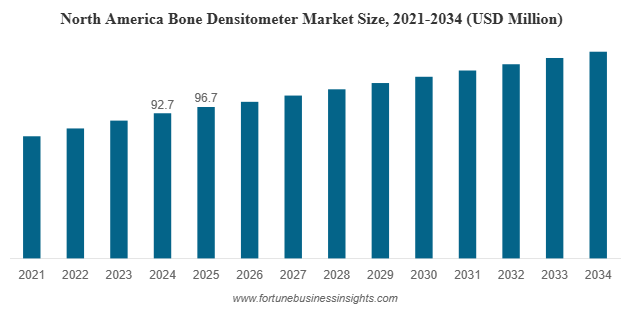
North America dominated the global bone densitometer market in 2025, with a valuation of USD 96.7 million. The region’s leadership is supported by high awareness levels, comprehensive reimbursement frameworks, and large installed bases of densitometry systems facilitating replacement and upgrades. Within North America, the United States accounts for roughly one-third of global revenues.
Europe ranks as another significant market, propelled by aging populations and government-led screening initiatives that promote early detection of bone diseases. Mature healthcare infrastructure and public health strategies contribute to steady regional growth.
The Asia Pacific market is forecast to grow substantially, supported by rapidly aging populations in China, Japan, and South Korea, as well as expanding private diagnostic networks that improve access to bone health screening services. India and China are emerging as key growth markets within the region.
Latin America and the Middle East & Africa are also expected to register moderate growth due to rising awareness of bone health and incremental improvements in healthcare infrastructure.
Competitive Landscape
The global bone densitometer market is moderately consolidated, with several multinational imaging and diagnostic companies maintaining significant market presence.
Prominent players profiled in the report include GE Healthcare, Hologic, Inc., OsteoSys Corp., Swissray, BeamMed Inc., FUJIFILM Corporation, Ecolight S.p.A., DMS Group, Hitachi High-Tech Corporation, and FURUNO ELECTRIC CO., LTD.
Key players are focusing on research and development initiatives, strategic partnerships, and product launches to enhance their portfolios and technological capabilities. Recent developments include collaborations to introduce AI-based tools for improved fracture risk assessment, expansion of next-generation software solutions, and participation in major international healthcare exhibitions.
Ashwin Arora
Fortune Business Insights™ Pvt. Ltd.
+1 833-909-2966
sales@fortunebusinessinsights.com
Legal Disclaimer:
EIN Presswire provides this news content "as is" without warranty of any kind. We do not accept any responsibility or liability for the accuracy, content, images, videos, licenses, completeness, legality, or reliability of the information contained in this article. If you have any complaints or copyright issues related to this article, kindly contact the author above.
