

Global Automotive Fuel Tank Market Expands in Asia-Pacific as Toyota, Plastic Omnium & YAPP Lead Growth
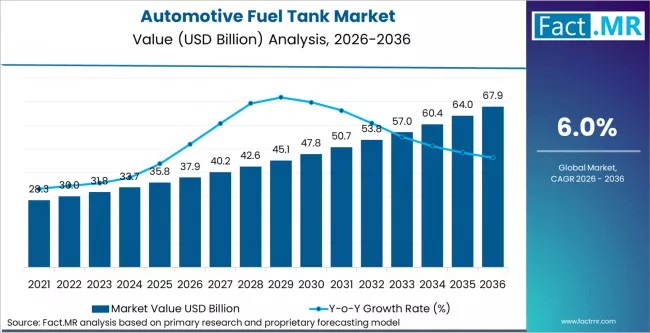
Global Automotive Fuel Tank Market grows with rising vehicle production, shift to lightweight materials, and demand for safer, emission-compliant fuel systems.
ROCKVILLE, MD, UNITED STATES, March 26, 2026 /EINPresswire.com/ -- In the architectural redesign of the modern vehicle, the fuel tank is no longer a static storage box. It has become a high-performance pressure vessel, a weight-saving asset, and a critical component in the global race toward zero-emissions compliance. As the industry navigates the "Bridge Era" of Hybrid Electric Vehicles (HEVs) and the frontier of Hydrogen-powered mobility, the Global Automotive Fuel Tank Market is undergoing its most significant structural evolution in decades.Valued at USD 21.60 Billion in 2026, the market is on a strategic trajectory to reach USD 37.38 Billion by 2036, expanding at a steady CAGR of 5.6%. For automotive CXOs and Tier-1 procurement leaders, this represents a USD 15.78 Billion absolute dollar opportunity centered on material science and integrated fuel-delivery systems.
For Details Deep insights, Please Request A sample report for Free: https://www.factmr.com/connectus/sample?flag=S&rep_id=26
Quick Stats: The Strategic Pulse (2026–2036)
Estimated Value (2026): USD 21.60 Billion
Projected Value (2036): USD 37.38 Billion
Forecast CAGR: 5.6%
Dominant Material: High-Density Polyethylene (HDPE) - 78% Market Share.
Leading Capacity: 45L to 70L Segment (62% share), dominant in the global SUV and Sedan markets.
The Decision-Maker’s Insight: 3 Pillars of Market Shift
The "Plastic-First" Lightweighting Mandate
The shift from traditional steel to Plastic (HDPE) Fuel Tanks is nearly complete in the passenger vehicle segment. Plastic tanks offer a 30% to 50% weight reduction over metal counterparts, which is vital for meeting stringent CAFE and Euro 7 fuel economy standards. Beyond weight, plastic's "blow-molding" flexibility allows engineers to maximize fuel volume in the irregular spaces created by complex EV battery packs and hybrid drivetrains.
The Pressurized Challenge of Hybridization
Hybrid Electric Vehicles (HEVs) and Plug-in Hybrids (PHEVs) present a unique engineering hurdle: fuel can remain in the tank for long periods without the engine running, leading to pressure buildup. This has catalyzed the demand for High-Pressure Plastic Tanks and advanced Fuel Tank Pressure & Vent Control Modules. Decision-makers are increasingly prioritizing "Active" fuel systems that prevent vapor leakage while maintaining structural integrity during long electric-only drive cycles.
Hydrogen Storage: The New Frontier
While liquid fuels remain the volume backbone, the infrastructure for Type IV Hydrogen Tanks (composite-overwrapped pressure vessels) is seeing massive R&D investment. For heavy-duty and long-haul commercial vehicle OEMs, the ability to store hydrogen at 700 bar is the new benchmark for "Green Logistics," creating a high-margin niche within the traditional fuel storage sector.
Regional Growth & Compliance Hubs
Asia-Pacific (Largest Market): Accounting for approximately 45% of global revenue, led by China (6.5% CAGR) and India (6.8% CAGR). Growth is fueled by massive domestic production and the rapid adoption of localized Bharat Stage (BS) VI and China 6 emission standards.
Germany (4.8% CAGR): The epicenter of premium engineering, where the focus is on developing zero-evaporative-emission (ZEV) compliant tanks for luxury exports.
United States (4.2% CAGR): Driven by the sustained popularity of Light Trucks and SUVs, where higher fuel capacities (Above 70L) and robust material durability are paramount.
Executive Takeaway
The automotive fuel tank is transitioning from a commodity to a compliance-critical system. The future of the market lies in Integrated Fuel Tank Modules—units that house the pump, sensors, and filtration within a single, lightweight shell. Suppliers who can offer "Low-Permeation" multi-layer plastic technology will secure the most significant long-term contracts as global emissions legislation moves toward a "Zero-Leakage" standard.
For instant access to this report, click “Buy Now” or connect with our analyst for customization: https://www.factmr.com/checkout/26
To View Related Report:
Automotive Ignition System Market https://www.factmr.com/report/37/automotive-ignition-market
Automotive Fuel Tank Market https://www.factmr.com/report/26/automotive-fuel-tank-market
Automotive Steering System Market https://www.factmr.com/report/43/automotive-steering-system-market
V2X Bidirectional EV Charger Market https://www.factmr.com/report/v2x-bidirectional-ev-charger-market
About Fact.MR
Fact.MR is a global market research and consulting firm, trusted by Fortune 500 companies and emerging businesses for reliable insights and strategic intelligence. With a presence across the U.S., UK, India, and Dubai, we deliver data-driven research and tailored consulting solutions across 30+ industries and 1,000+ markets. Backed by deep expertise and advanced analytics, Fact.MR helps organizations uncover opportunities, reduce risks, and make informed decisions for sustainable growth.
S. N. Jha
Fact.MR
+ +1 628-251-1583
sales@factmr.com
Legal Disclaimer:
EIN Presswire provides this news content "as is" without warranty of any kind. We do not accept any responsibility or liability for the accuracy, content, images, videos, licenses, completeness, legality, or reliability of the information contained in this article. If you have any complaints or copyright issues related to this article, kindly contact the author above.
